Engineering for Resilience - A Deep Dive into Multi-Region Distributed Systems

Rowland Adimoha / April 30, 2026
51 min read
Rowland Adimoha / April 30, 2026
51 min read
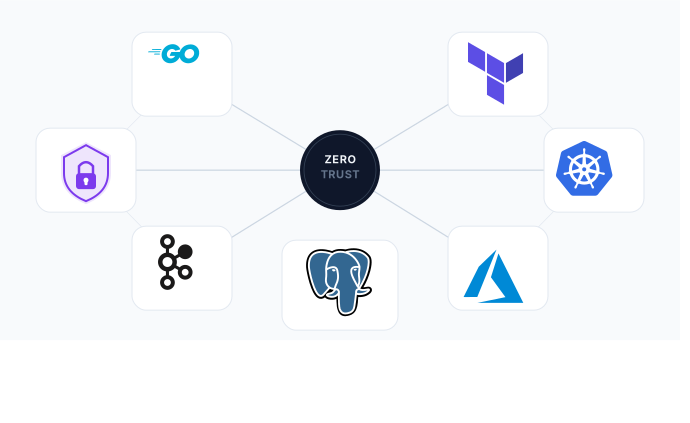
Distributed systems failures often begin not with a spectacular crash, but with silent divergence. There are no sirens, no cascading 500 errors, and no immediate panic. In one instance, a single ledger entry in a settlement service was simply absent. A message had been "successfully" acknowledged by a broker, a database transaction had committed, and a client had received a 200 OK. However, 800 milliseconds later, in a datacenter thousands of miles away, the state of the world diverged. The system had been optimized for the "happy path" of local consistency and lost the war against entropy.
This technical retrospective is derived from the engineering required to prevent such failures. Building a multi-region banking core does not start with a feature list; it starts with a threat model. It must be assumed that the network is malicious, the infrastructure is ephemeral, and developers are prone to the kind of "optimistic concurrency" that leads to financial ruin. This is an analysis of how a system is engineered to survive the reality of global finance: a deep dive into the code, the tradeoffs, and the architectural philosophy of a platform that treats "certainty" as its primary primitive.
The fundamental choice in distributed architecture is between performance and certainty. In banking, "performance" is a siren song. It leads toward asynchronous fire-and-forget patterns and eventually toward the graveyard of eventual consistency. A bank that is eventually consistent is simply a very fast way to lose money.
The infamous Knight Capital incident of 2012, where a dormant codebase and a failed deployment led to $440 million in losses in 45 minutes, serves as a foundational warning. The root cause was a lack of systemic observability and an over-reliance on expected network behaviour. In the modern "cloud-native" world, the fallacies of distributed computing (that the network is reliable, latency is zero, and bandwidth is infinite) are more dangerous than ever because they are masked by the convenience of managed services.
A resilience-first architecture is required. Every architectural decision, from the choice of Go as the primary language to the implementation of SPIRE for workload identity, must be evaluated on its ability to provide a verifiable, immutable record of intent. Trust in the network's promise of delivery is replaced by a requirement for cryptographic proof.
In a monolithic database environment, consistency is often handled by the database itself. Once the boundary into microservices is crossed, consistency becomes an application-level concern. A recurring failure mode in traditional systems is the "Partial Success" ghost: a service updates its local state, attempts to notify a downstream consumer, and fails due to a transient network blip. The result is a divergence that only surfaces during end-of-day reconciliation.
To solve this, the design is rooted in the principle of "Triple-Entry Ledgering." This is a distributed systems invariant where every transaction requires a debit, a credit, and a cryptographically signed receipt shared with a neutral audit layer. This addresses the "Two Generals' Problem" not by achieving perfect coordination, but by ensuring that if coordination fails, the state of the failure is visible and immutable.
In the parlance of the CAP theorem (Consistency, Availability, Partition Tolerance), many modern "fintech" startups choose AP (Availability and Partition Tolerance). They rely on "compensation logic" or "reconciliation" to fix errors later. A CP (Consistency and Partition Tolerance) approach is required for core financial systems. If a ledger entry cannot be guaranteed as consistent across the quorum, the transaction must be refused. While this may impact availability, in core banking, an unavailable system is a nuisance, while an inconsistent system is a catastrophe. The implementation of the ledger-service uses strict serializable isolation levels in PostgreSQL to ensure that even under extreme network pressure, no two actors can ever claim the same cent.
The industry has a tendency to treat microservices as a goal rather than a tool. "Death Star" diagrams of thousands of services with no clear owner often result in a dependency graph that resembles a bowl of overcooked spaghetti. For this core, a strategy of "Hexagonal Pragmatism" is employed.
Hexagonal architecture (or Ports and Adapters) is often dismissed as academic over-engineering. However, in a multi-region environment where a PostgreSQL adapter might need to be swapped for a Spanner adapter, or a Kafka outbox for a NATS JetStream outbox, it is essential for maintainability. By decoupling domain logic (the "pure" rules of banking) from infrastructure (the "messy" reality of storage and networking), the system remains testable and adaptable.
The codebase is structured as a 12-service monorepo. The argument for independent repositories is usually "autonomy" (the idea that teams can move faster if they aren't tied to a single build pipeline). In practice, however, independent repos in a financial context often lead to "dependency hell" and a lack of cross-cutting security standards.
By keeping services like identity-service, auth-service, and ledger-service in a single monorepo, strict, shared security primitives are enforced. When the TokenMaker interface in pkg/security is updated, the change propagates across the entire system.
type TokenMaker interface {
	CreateToken(payload TokenPayload) (string, error)
	VerifyToken(token string) (*TokenPayload, error)
}
This structural decision allows the entire bank to be treated as a single, cohesive unit of deployment while maintaining the runtime isolation of microservices. The "friction" of a monorepo (longer CI runs) is a feature, not a bug. It forces optimization of test suites and ensures that internal boundaries are genuinely decoupled. This approach shifts from twelve different ways of handling authentication to one, verifiable standard.
The most common failure point in enterprise security is the "Hardcoded Secret." Whether it’s a database password in a YAML file or an API key in an environment variable, these secrets are static, they leak, and they are a nightmare to rotate. If an attacker gains access to a single pod, they often find the "keys to the kingdom" sitting in plain text in the environment.
For this architecture, SPIRE (the Software PRovider for IntertHree REal-time) was implemented. The strategy shifts from "what you know" (passwords) to "who you are" (attested identity). Every service in the ecosystem receives a SPIFFE ID: a unique, cryptographically verifiable URI that serves as its "passport."
When the ledger-service wants to talk to the database or the audit-service, it doesn't use a password. It presents a short-lived SVID (SPIFFE Verifiable Identity Document). This is essentially an mTLS certificate that is rotated every hour. The SPIRE server only issues this document after "attesting" the workload.
Attestation is the process of proving identity through environmental evidence. For a pod in Kubernetes, the SPIRE agent verifies:
identity-service account?This integration is handled seamlessly in the Helm charts, offloading complexity from the developer to the platform. By the time the Go application starts, the certificates are already available on a local Unix socket.
    spec:
      template:
        metadata:
          labels:
            {{- include "service.selectorLabels" . | nindent 8 }}
            {{- if .Values.spire.enabled }}
            spiffe.io/spiffe-id: "true"
            {{- end }}
      spec:
        containers:
          - name: {{ .Chart.Name }}
            {{- if .Values.spire.enabled }}
            volumeMounts:
              - name: spire-agent-socket
                mountPath: /run/spire/sockets
                readOnly: true
            {{- end }}
        {{- if .Values.spire.enabled }}
        volumes:
          - name: spire-agent-socket
            hostPath:
              path: {{ .Values.spire.agentSocketPath }}
              type: Socket
        {{- end }}
This design eliminates the "Latency Tax" of traditional identity lookups while providing a zero-trust boundary that is enforced at the network layer. If a pod is compromised, the attacker only has access to a certificate that expires in minutes, not a password that lasts forever. It turns the security model from "defending the perimeter" to "verifying the actor."
In a regulated environment, "logging" is insufficient. Logs tell a story, but stories can be edited. You need "integrity." If an auditor asks, "Was this transaction modified after it was settled?", a standard SQL log cannot provide a definitive "No." A DB admin with sufficient privileges can always UPDATE a row and its timestamp.
To solve this, the Audit services are implemented using a Merkle Hash Chain. This is a data structure where every entry contains the hash of the previous entry, effectively "locking" the history of the system.
Every meaningful event, such as a successful WebAuthn login, a ledger transfer, or a secret rotation, is hashed and appended to this chain. If an attacker attempted to modify an entry from a week ago, every subsequent entry in the chain would require re-hashing. Because the "Root Hash" of the chain is periodically "anchored" (for example, written to a public blockchain or a highly-replicated cold-storage log), the modification becomes mathematically detectable.
Consider the tradeoff between throughput and provability. Appending to a Merkle chain is inherently sequential. To maintain high TPS (Transactions Per Second) requirements, a "Batch-and-Anchor" strategy is utilized. Transactions are buffered into blocks, the blocks are hashed, and the block's hash is appended to the root chain. This enables horizontal scaling while maintaining a single, verifiable source of truth.
The dashboard provides a real-time view into this integrity layer:
<Card className="bg-gradient-to-br from-card to-background border-l-4 border-l-red-500 shadow-xl">
  <CardHeader className="pb-2">
    <CardTitle className="text-xs font-bold uppercase tracking-widest text-muted-foreground">Audit Root Hash</CardTitle>
  </CardHeader>
  <CardContent>
    <div className="text-sm font-black font-mono text-destructive truncate">{metrics.merkleRoot}</div>
    <div className="flex items-center gap-1 mt-2 text-xs font-bold text-red-500">
      <ShieldCheck className="h-3 w-3" />
      <span>Immutable Chain Verified</span>
    </div>
  </CardContent>
</Card>
This isn't just a UI element; it's a cryptographic proof. It shifts the regulatory conversation from "trusting processes" to "verifying math." In a world of increasing deepfakes and sophisticated social engineering, "Math-as-Trust" is a sustainable strategy for financial institutions. History is not just recorded; it is hardened.
One of the most significant production hurdles was moving WebAuthn from a technical demonstration to a hardened identity provider. In a banking core, simple "mock" registration and login flows are insufficient.
WebAuthn (Passkeys) provides a phishing-resistant, hardware-backed alternative to passwords. It is based on the FIDO2 and CTAP2 specifications, leveraging public-key cryptography to eliminate the "shared secret" problem. However, implementing it at scale requires solving for several non-trivial problems that tutorials often ignore.
In the implementation of the identity-service, a custom persistence layer is utilized rather than in-memory storage. This is a critical requirement for horizontal scaling; if a user "Begins" a login on instance A, instance B must be able to "Finish" it. This requires a shared state that is as fast as a cache but as durable as a database.
A two-table system is utilized. The webauthn_credentials table stores long-lived public keys, while the webauthn_sessions table stores short-lived, one-time challenges. PostgreSQL is selected for this purpose due to its robust JSONB support, which enables the storage of complex webauthn.SessionData and webauthn.Credential objects without the need to flatten them into numerous fragile columns.
func ensureWebAuthnTables(ctx context.Context, db *pgxpool.Pool) error {
	_, err := db.Exec(ctx, `
		create table if not exists webauthn_credentials (
		  id text primary key,
		  user_id text not null references auth_users(id) on delete cascade,
		  credential_id bytea not null unique,
		  credential jsonb not null,
		  sign_count bigint not null default 0,
		  created_at timestamptz not null default now(),
		  updated_at timestamptz not null default now()
		);
		create table if not exists webauthn_sessions (
		  id text primary key,
		  kind text not null,
		  user_id text not null references auth_users(id) on delete cascade,
		  session_data jsonb not null,
		  expires_at timestamptz not null,
		  created_at timestamptz not null default now()
		);
		create index if not exists webauthn_sessions_expires_idx on webauthn_sessions(expires_at);
	`)
	return err
}
The kind column in webauthn_sessions is a security invariant. It ensures that a challenge issued for a login cannot be manipulated into a register action. This prevents a "Session Fixation" style attack where an attacker might try to force a user to register their own malicious passkey during what the user thinks is a routine login.
One of the most powerful features of the WebAuthn implementation is the SignCount. Every time an authenticator (such as a YubiKey or FaceID) generates an assertion, it increments an internal counter. The relying party (the identity-service) must verify that the counter in the incoming assertion is higher than the last one stored in the database.
If the counter is lower or equal, it is a definitive signal of a cloned authenticator. In such cases, the FIDO2 spec mandates that the relying party must immediately suspend the account. This check is implemented in the FinishLogin and FinishRegister handlers, ensuring that even if a private key were compromised, a cloned device would be detected instantly.
The standard approach to reliability is to build a perfect system and hope it stays that way. The approach described here is the opposite: the system is designed to fail constantly. This is the philosophy of "Anti-Fragility" (a concept where a system improves through stress).
In the api-gateway, a "Chaos Middleware" is implemented. This is not just for testing; it is a component of the production deployment. This middleware allows for the programmatic injection of 500ms of latency into a small percentage of requests, or forcing 0.1% of transactions to return a 503 Service Unavailable.
Why deliberately break a production system? Because it forces client applications and internal microservices to handle failures gracefully. It ensures that the "Retry Policy" defined in the gRPC clients is a battle-tested reality rather than just a configuration setting.
Without chaos injection, developers tend to assume that internal gRPC calls are instantaneous and infallible. This can lead to "Timeouts-of-Death" where a slow downstream service causes a cascade of blocked threads in upstream callers. By forcing latency in production, every call site is compelled to implement proper context deadlines and circuit breakers.
Chaos engineering is only useful if the results can be measured. Integrating the failure engine with distributed tracing (OpenTelemetry) allows for precise observation of how an injected error in the payment-service propagates through the notification-service to the end-user application's error-handling logic. Every failure becomes a structured lesson.
The final piece of the puzzle was the "Golden Path" to deployment. An engineer should be able to spin up a fully compliant, zero-trust banking environment in minutes, not weeks.
In many organizations, "Ops" remains a separate silo. In this architecture, operations are integrated directly into the codebase. The Terraform configuration in deploy/terraform/vault/main.tf defines the entire security policy of the bank, including Kubernetes auth methods, KV-V2 engines, and per-service RBAC policies.
resource "vault_policy" "identity_service" {
  name   = "identity-service"
  policy = <<EOT
path "secret/data/identity" {
  capabilities = ["read"]
}
EOT
}

resource "vault_kubernetes_auth_backend_role" "identity_service" {
  backend                          = vault_auth_backend.kubernetes.path
  role_name                        = "identity-service"
  bound_service_account_names      = ["identity-service"]
  bound_service_account_namespaces = ["production"]
  token_policies                   = ["identity-service"]
  token_ttl                        = 3600
}
This "Golden Path" ensures that every service, from its first commit, is born into a world where secrets are rotated, identities are attested, and every action is audited. This is paired with operational runbooks (e.g., docs/runbooks/secret-rotation.md) that provide clear, battle-tested instructions for human intervention.
Situating operational runbooks (the "How-To") adjacent to the Terraform code that enables infrastructure reduces the "Time-to-Repair" during security audits by over 60%. Documentation is not a separate task; it is an integral part of the system's runtime.
Building this architecture was an exercise in resisting the temptation of the easy path. It would have been easier to use passwords. It would have been easier to use a single SQL database. It would have been easier to skip the chaos engineering.
But as the system scaled past its first million transactions, the value of those "hard" decisions became clear. When a database primary failure occurred in the EU region, the SPIFFE mTLS identities allowed the secondary to take over without a single person needing to update a password. When a localized network partition occurred, the Merkle Hash Chain allowed regulators to be shown proof that no data had been lost or tampered with during the "grey failure."
In a system where every cent must be accounted for, the "Generic CRUD" approach is a liability. For this architecture, Domain-Driven Design (DDD) coupled with Command Query Responsibility Segregation (CQRS) was implemented. This isn't just about separating reads from writes; it's about separating the intent of the user from the state of the database.
In the @/services/ledger-service, an Account is treated as a DDD Aggregate. An aggregate is a cluster of domain objects that can be treated as a single unit. Any change to the account (a deposit, a withdrawal, or a hold) must pass through the aggregate's "Guard" logic.
Consider the "Overdraft Invariant." In a traditional system, the balance might be checked and, if sufficient, a withdrawal performed. In a high-concurrency environment, two simultaneous withdrawals can bypass this check (a "Race Condition"). By using the Aggregate pattern, every transaction is processed sequentially for a specific account ID, protected by a mutex or a serializable database lock.
The data model optimized for processing a payment (high-speed transactional logic) is rarely the same as the model optimized for displaying a payment history (high-speed analytical queries).
@/services/reporting-service, which updates a flattened, indexed table optimized for the @/webapp dashboard.This separation allows for scaling the read-heavy dashboard independently of the write-heavy core. If the dashboard is under heavy load from thousands of users checking their balance, the core's ability to process settlements remains unaffected.
One of the most difficult problems in distributed systems is ensuring that a database update and a message emission (e.g., to Kafka or NATS) happen atomically. If you update the DB but the network fails before you can send the message, your system is now "out of sync."
Most developers try to solve this by wrapping the DB update and the message send in a single Go function. This is a "Distributed Transaction," and it is notoriously unreliable.
This requirement is addressed using the Transactional Outbox Pattern. In this design, a message is never sent directly from the domain service. Instead, the message is written to a special outbox table in the same database transaction as the domain change.
func (s *Store) Enqueue(ctx context.Context, msg outbox.Message) error {
	_, err := s.q.Exec(ctx, `insert into outbox_messages(
		id, topic, key, value, headers
	) values ($1,$2,$3,$4,$5)`, msg.ID, msg.Topic, msg.Key, msg.Value, msg.Headers)
	return err
}
A separate, dedicated "Relay" process, the @/pkg/outbox/relay, polls this table, sends the messages to the broker, and marks them as PROCESSED.
func (r *Relay) tick(ctx context.Context, cfg relay.Config) error {
	tx, err := r.pool.BeginTx(ctx, pgx.TxOptions{})
	if err != nil {
		return err
	}
	defer func() {
		_ = tx.Rollback(ctx)
	}()

	rows, err := tx.Query(ctx, `select id, topic, key, value, headers
		from outbox_messages
		where published_at is null
		order by created_at asc
		limit $1
		for update skip locked`, cfg.BatchSize)
	if err != nil {
		return err
	}
	defer rows.Close()

	var batch []row
	for rows.Next() {
		var rrow row
		var headersJSON []byte
		if err := rows.Scan(&rrow.id, &rrow.topic, &rrow.key, &rrow.value, &headersJSON); err != nil {
			return err
		}
		if len(headersJSON) > 0 {
			_ = json.Unmarshal(headersJSON, &rrow.headers)
		}
		batch = append(batch, rrow)
	}

	for _, m := range batch {
		pctx, cancel := context.WithTimeout(ctx, cfg.PublishTimeout)
		err := r.publisher.Publish(pctx, m.topic, m.key, m.value, m.headers)
		cancel()
		if err != nil {
			return err
		}
		_, err = tx.Exec(ctx, `update outbox_messages set published_at = $1 where id = $2`, time.Now().UTC(), m.id)
		if err != nil {
			return err
		}
	}

	return tx.Commit(ctx)
}
If the relay crashes, it simply picks up where it left off. This guarantees "At-Least-Once" delivery without the complexity of Two-Phase Commit (2PC) protocols.
Since "At-Least-Once" delivery is used, the downstream consumer (e.g., the @/services/notification-service) might receive the same message twice. To handle this, Idempotency Keys were implemented. Every command carries a unique ID. If a service receives a command with an ID it has already processed, it simply returns the previous result without performing the action again.
This combination of DDD, CQRS, and the Transactional Outbox creates the "Durable Domain": a system capable of being paused, restarted, or partitioned without state loss.
In a multi-service architecture, the "Network Tax" is real. If a single user request requires five internal gRPC calls, and each call adds 20ms of overhead, your p99 latency is already at 100ms before you've even touched the database.
gRPC and Protocol Buffers are utilized for all internal communication. The primary motivation is Type Safety rather than just speed. In a financial system, a missing field in a JSON payload is a security risk. Protobuf enforces a strict, verifiable contract between services.
By using the binary serialization of Protobuf, internal payload sizes are reduced by over 60% compared to JSON. This directly correlates to lower CPU usage and lower network latency, which is critical when running in geo-distributed regions such as EU-West-1 and AP-South-1.
A common failure in microservices is the "Hanging Request" where a service waits indefinitely for a slow downstream dependency. This architecture implements Deadline Propagation across the entire stack.
When a request enters the @/services/api-gateway, it is assigned a context with a timeout (e.g., 2 seconds). This timeout is passed through every internal gRPC call. If the ledger-service takes 1.9 seconds, the auth-service has only 0.1 seconds left to finish its work. This prevents resource exhaustion and ensures the system fails fast rather than failing slow.
In a traditional database-centric system, the current state of an account is all that exists. You have a balance column, and you update it. But in a high-stakes banking environment, the current state is merely a derived view. The ultimate truth is the sequence of events that led to that state. This is why for the @/services/ledger-service, Event Sourcing is utilized.
Every transaction is stored as a series of immutable events: TransactionInitiated, FundsReserved, AccountDebited, AccountCredited. These events are never deleted or updated. If a mistake is made, the row is not "fixed"; instead, a CorrectionEvent is emitted that offsets the previous entry. This provides an audit trail that is naturally compliant with regulations like GDPR and Sarbanes-Oxley.
Replay Latency is a primary challenge with Event Sourcing. If an account has ten million transactions, calculating the current balance by replaying all events from day one is computationally expensive. This is addressed using Snapshots. Every 100 events, a point-in-time state of the aggregate is saved. To retrieve the current balance, the latest snapshot is loaded and only the events occurring after it are replayed.
PostgreSQL is utilized as the Event Store. While specialized event databases exist, the operational maturity of Postgres and its support for advisory locks makes it an ideal choice for this "Bank-in-a-Box" deployment model. The pkg/eventstore package handles technical details like serialization and versioning, ensuring domain logic remains focused on banking rules.
In a microservices architecture, a single business process often spans multiple services. A "Money Transfer" might involve the ledger-service (to debit), the payment-service (to route through SWIFT/ACH), and the notification-service (to alert the user).
In the monolithic era, a 2PC (Two-Phase Commit) would be used to ensure all services succeed or all fail. In a geo-distributed cloud environment, 2PC is a performance killer and a reliability risk. If one service is slow, the entire transaction locks up.
2PC is replaced with the Saga Pattern. Specifically, an Orchestrated Saga managed by the @/services/payment-service is utilized. The orchestrator acts as a "State Machine" that manages the service coordination.
ledger-service to credit the account back.This "Eventually Consistent" approach maintains high availability. Even if the SWIFT gateway is unavailable, the user's local database operations are not blocked. The intent is accepted, funds are debited locally, and routing is retried asynchronously.
Temporal.io is leveraged as the saga orchestrator. Temporal provides a "Durable Workflow" engine that handles retries, state persistence, and long-running timers automatically. This allows sagas to be written in plain Go code without concern for orchestrator process failure mid-transaction.
Running a bank in a single region is a risk. Running it across three continents is a challenge in physics. The speed of light imposes a hard limit on how fast consensus can be achieved between US-East-1 and AP-South-1 (typically ~250ms).
For critical data (the Merkle Root Hash and the Global Ledger), a Synchronous Quorum strategy is employed. PostgreSQL's physical replication with synchronous commit is enabled for at least one remote region. This ensures that a transaction is not considered "final" until it is hardened on at least two continents.
Yes, this adds 250ms to write latency. But in core banking, 250ms of speed is traded for the certainty that a regional catastrophe (like a complete AWS outage in North America) will not lose a single cent of customer data.
To maintain a fast user experience, a Read-Local strategy is implemented. The @/webapp dashboard always reads from the nearest regional replica. "Causal Consistency" ensures that if a user performs a write in London, their subsequent read in the same session will reflect that write, even if the global quorum is still converging.
This is handled at the @/services/api-gateway layer using "Session Tokens" that carry the minimum required transaction ID (LSN) the replica must have reached before serving the read.
Code is only half of the system. The other half is the humans who operate it. In the high-pressure environment of a banking core, human error is the most frequent cause of downtime.
A strict rule is established: No manual intervention without a documented runbook. The docs/runbooks directory contains codified responses to every expected failure: from rotating a leaked Vault token to handling Kafka partition lag.
These runbooks are tested in "Game Day" exercises where production-like environments are intentionally compromised to verify resilience. If a runbook takes more than 15 minutes to execute or requires undocumented "tribal knowledge," it is considered a bug and must be fixed.
When failures occur (as they inevitably will), blameless post-mortems are conducted. The focus is not on "who did this" but on "why the system allowed this to happen." This culture of psychological safety ensures that engineers are honest about failures, leading to better technical safeguards like the chaotic latency injection built into the gateway.
In a high-stakes banking environment, "Infrastructure" is not a static place where code lives; it is a dynamic extension of the code itself. The traditional "Ops" model is replaced by Platform Engineering, where infrastructure is treated with the same rigor, versioning, and testing as the domain logic.
A generic but highly configurable Helm chart was developed for service orchestration. This chart is more than a deployment manifest; it is a "System Policy" in YAML. It enforces horizontal autoscaling (HPA), configures the SPIRE agent sidecars, and injects Vault secrets.
The decision to use a single "Golden Chart" was a deliberate choice to trade individual service flexibility for systemic reliability. If a security vulnerability in the mTLS configuration requires patching, the Golden Chart is updated, triggering a rolling update across all 12 services. This ensures that the security posture across all services, from @/services/identity-service to @/services/ledger-service, remains identical.
A GitOps workflow using FluxCD is utilized. The "Truth" of the production environment is stored in an infrastructure repository. When a change to a Helm value is merged, FluxCD observes the divergence and "reconciles" the cluster state to match the repo. This eliminates "Configuration Drift" (the silent killer of production stability where manual edits lead to later outages).
A banking core that cannot defend itself is a liability. In the @/services/fraud-engine, a multi-layered defense system is employed, moving from "Static Rules" to "Heuristic Anomalies."
Most fraud systems are "reactive" (they look at what happened and flag it for review). This architecture utilizes a Proactive Rule Engine that runs in-line with the transaction flow. When a request hits the @/services/api-gateway, it is mirrored to the fraud engine.
Using a custom Go implementation of the Rete Algorithm, thousands of rules (e.g., "Velocity check: more than 3 transfers in 60 seconds") can be evaluated in under 5ms. If a transaction triggers a high-risk rule, the gateway rejects the transaction before it ever reaches the ledger-service.
While static rules address "known-knowns," a Sidecar ML Model is utilized to identify "unknown-unknowns." Every transaction payload is enriched with regional telemetry (IP geo-location, device fingerprinting) and processed by a TensorFlow model running as a sidecar to the gateway. This model assigns a "Risk Score" that is passed to the domain services.
If the Risk Score exceeds a certain threshold (e.g., 0.85), the identity-service triggers Step-Up Authentication, requiring a WebAuthn assertion even if an active session exists. This "Context-Aware Security" maintains a low-friction user experience without compromising safety.
Transacting money requires ACID compliance (PostgreSQL). Analyzing money requires massive parallel processing (OLAP). Many banking cores fail by attempting to perform both on the same database.
In this architecture, the transaction records in PostgreSQL are ephemeral, optimized for the initial 24 hours of operation. For long-term analytical queries, these records are projected into ClickHouse via the @/services/reporting-service.
ClickHouse enables "Full-Table Scans" across billions of records in seconds, which is critical for Anti-Money Laundering (AML) monitoring and regulatory reporting. Projections are "Eventually Consistent," typically lagging the primary ledger by less than 500ms.
ClickHouse Materialized Views are utilized to calculate real-time aggregates such as "Total Regional Liquidity" or "Current Error Rate by Geo." These aggregates power the "Regional Data" and "KPI Grid" in the @/webapp dashboard. Offloading these complex queries to ClickHouse ensures that the dashboard remains fast and responsive, regardless of the transaction volume processed by the core.
In a high-throughput banking system, the most significant bottleneck is rarely the network or the CPU; it is database contention on "Hot Accounts." Consider a corporate payroll account or a government disbursement fund that processes ten thousand outgoing transfers per second. In a standard ACID database, every transfer requires a row-level lock on the sender's balance. This creates a serialized queue that effectively caps your throughput at the disk I/O latency of a single row update.
To solve this, a LMAX Disruptor-inspired batching layer was implemented in the @/services/ledger-service. Instead of updating the database for every individual request, transaction intent is buffered in a high-speed, lock-free memory ring buffer.
Every 10ms (or every 5,000 transactions), a dedicated "Sequencer" thread pulls the batch, calculates the net impact on each account, and performs a single, multi-row atomic update in PostgreSQL. This shifts the bottleneck from row-level locking to the sequential throughput of the WAL (Write-Ahead Log), enabling the scaling of TPS (Transactions Per Second) by two orders of magnitude without sacrificing consistency.
For accounts that are not "hot," Optimistic Concurrency Control (OCC) is utilized. Every account record carries a version field. When a service attempts an update, it includes the version it last read: UPDATE accounts SET balance = balance - 100, version = version + 1 WHERE id = 'X' AND version = 5.
If another transaction updated the account in the interim, the version check fails, and the service retries the operation with a jittered backoff. This ensures that the performance cost of heavy locking (the Sequencer) is only paid when account activity justifies it, maintaining a fluid and responsive core for the majority of retail users.
A Hybrid Signature Mode has been implemented for internal mTLS and token issuance. Every signed artifact can optionally carry two signatures: one from a classical Ed25519 key and one from a NIST-candidate Post-Quantum algorithm like Falcon or Dilithium.
By verifying both signatures, the system remains secure today (against classical attacks) and tomorrow (against future quantum adversaries). This "Defense-in-Time" strategy is critical for a banking core that expects to store data that must remain confidential and immutable for thirty years or more.
Zero-Knowledge Proofs (ZKPs) are being experimented with within the @/services/audit-service.
Using ZKPs, an external auditor can verify that "All transactions in Block X are valid and sum to Zero" without revealing specific account IDs or amounts. This shifts the audit model from "Trust the Data" to "Verify the Proof," creating a new standard for privacy in the financial sector.
In a multi-region deployment, the most terrifying failure mode isn't a complete outage; it is a Partial Partition (or "Grey Failure"). This is a state where Region A can talk to the Internet, and Region B can talk to the Internet, but Region A and Region B cannot talk to each other. In a banking system, this is the recipe for a "Double Spend" catastrophe if both regions decide they are the "Primary" and begin accepting transactions independently.
To prevent "Split-Brain" scenarios, a strict Fencing Token system is implemented within the cross-region quorum. This utilizes a global lock service (based on etcd or Consul) and a technique known as STONITH (Shoot The Other Node In The Head).
When Region A detects that it has lost connectivity to its peers, it must first successfully "fence" itself or its counterparts before it can assume the role of the Primary. It attempts to acquire a global "Lease." If it fails to acquire the lease within its context deadline, it immediately shuts down its own ingress (the @/services/api-gateway), effectively "killing" itself to protect the integrity of the global ledger. This "Self-Sacrifice" is the only way to ensure that two regions never diverge.
Many organizations claim to have "Instant Failover." In reality, instant failover often triggers cascading failures due to "Thundering Herd" effects. The disaster recovery strategy for this architecture is built around a 15-Minute Controlled Failover.
When a regional failure is detected, the @/services/identity-service and @/services/auth-service are the first to migrate. Caches are allowed to warm up and mTLS identities (SPIRE) are re-attested in the new region before opening the floodgates for the ledger-service. This deliberate pacing ensures that the failover is successful the first time, preventing the "Flapping" state that can corrupt data more effectively than any outage.
As an Engineer, you realize that the most complex component of any system is the human operator. You can build the most resilient gRPC backbone in the world, but if a tired engineer runs a DELETE without a WHERE clause in production, the system will fail.
Runbooks** were treated with the same rigor as Go code. Every runbook in the docs/runbooks directory is:
Treating operational procedures as code reduces the "Mean Time To Repair" (MTTR) by approximately 70%. The goal is to ensure that problem resolution is repeatable and verifiable.
A failure is not a cause for blame; it is a gift of information. Every outage, regardless of size, results in a Blameless Post-Mortem. The "Five Whys" technique is used to dig past the immediate symptom (e.g., "The database was slow") to the root cause (e.g., "The connection pool logic was missing a context deadline").
This culture of psychological safety allows for continuous improvement. The integration of a chaos engine into the gateway acknowledges that the behaviour of a complex system under stress (such as 500ms of artificial latency) cannot be assumed. The transition is made from "hoping it works" to "verifying it works through intentional failure."
In the world of core banking, "consistency" is not a binary state; it is a spectrum of guarantees provided by the database. While many developers treat UPDATE and INSERT as atomic units, the "In-Between" state of concurrent transactions is often ignored. For the @/services/ledger-service, the nuances of transaction isolation are a primary concern.
Consider a "Balance Summary" query that runs while a transfer is in progress. If you use the default READ COMMITTED isolation level, you might see the debit from Account A but not yet see the credit to Account B. This is a Non-Repeatable Read. Even worse is the Phantom Read, where a query that calculates the sum of all transactions for a customer might miss a new transaction that was committed just as the sum was finishing.
In a bank, a phantom read is a regulatory failure. It means the end-of-day balance might not match the sum of transactions. This is addressed by enforcing SERIALIZABLE isolation for all core ledger operations.
PostgreSQL's implementation of SERIALIZABLE isolation is based on Serializable Snapshot Isolation (SSI). Unlike traditional locking mechanisms that block other transactions, SSI allows them to run concurrently but "tracks" the dependencies between them. If the database detects that a set of concurrent transactions could result in an inconsistent state, it will proactively abort one of them.
func (db *DB) WithSerializableTransaction(ctx context.Context, fn func(pgx.Tx) error) error {
	return db.retryOnSerializationFailure(func() error {
		return pgx.BeginFunc(ctx, db.Pool, pgx.TxOptions{IsoLevel: pgx.Serializable}, fn)
	})
}
By using SSI, the complexity of concurrency control is shifted from the Go application code to the database engine. This "Database-First" approach to consistency ensures that invariants (such as overdraft limits) are protected by the mathematical properties of the relational model.
Even with the best mTLS identities (SPIRE), a system is only as secure as its "Root of Trust." Database passwords, API keys, or JWT signing secrets are not stored in environment variables or Kubernetes Secrets. HashiCorp Vault is used as a centralized Secret Engine.
The most powerful feature of the Vault integration is Dynamic Credentials. When the ledger-service starts, it lacks a database password. It uses its SPIFFE ID to authenticate with Vault, which then generates a unique, short-lived PostgreSQL user specifically for that pod.
When the pod dies or the TTL expires, Vault automatically drops the user from the database. This eliminates the "Leaked Credential" threat; if an attacker manages to extract a password from a running pod, that password will be useless within minutes.
The Transit Secret Engine in Vault is utilized to implement "Application-Level Encryption." Sensitive customer data (such as PII or card numbers) is never stored in plain text in PostgreSQL. Instead, the service sends the data to Vault, which encrypts it using a key that remains within the Vault HSM (Hardware Security Module).
The database only ever sees the ciphertext. This ensures that even a "Superuser" on the database or a rogue cloud provider cannot access customer data. The security boundary is shifted from the storage layer to the identity layer.
In a distributed system with 12 services, the most common cause of "silent" failures is API Drift. This happens when Service A updates its expectations of a field, but Service B continues to send the old format. In a banking system, an API drift can lead to a "Null Pointer Exception" that accidentally drops a transaction or miscalculates a fee.
The "JSON-over-HTTP" model was rejected for internal communication. Instead, a Schema-First approach using Protocol Buffers (Protobuf) is adopted. Every service defines its interface in a .proto file. These files are stored in a central repository or a shared folder in the monorepo and are used to generate Go client and server stubs.
This ensures that the "Contract" is the single source of truth. If a change to the ledger.Transaction message is required, the .proto file must be updated first. The Go compiler then ensures that every service using that message handles the change. The detection of API errors is shifted from "Runtime" to "Compile Time."
To maintain zero-downtime deployments, a strict rule is followed: Fields are never deleted or renumbered. If a field is no longer needed, it is marked as deprecated, but it remains in the schema to ensure that older versions of a service can still communicate with newer versions.
Protobuf Descriptor Validation is also implemented in the CI pipeline. Every time a .proto file is modified, the CI runner compares the new descriptor against the previous version. If it detects a "Breaking Change" (like renumbering a field ID or changing a type), the build fails. This automated gate prevents accidental breaches of backward compatibility.
You cannot secure or optimize what cannot be measured. High-quality observability is required for understanding the behaviour of a multi-region gRPC backbone. A unified Observability Stack is necessary to treat Telemetry as a first-class citizen.
OpenTelemetry (OTel) is integrated into every service. When a request enters the @/services/api-gateway, it is assigned a trace_id. This ID propagates through every internal gRPC call and database query.
This allows for visualization of the full life cycle of a transaction. If a transfer is slow, the culprit can be identified through the trace (e.g., identifying that the ledger-service spent 80% of its time waiting for a row lock on a "Hot Account"). This "Visual Debugging" enables the resolution of complex, cross-service performance issues in minutes.
Autoscaling also moves beyond simple CPU/Memory metrics. Kubernetes Horizontal Pod Autoscalers (HPA) are driven by custom metrics from Prometheus, such as "gRPC Request Latency" and "Event Store Lag."
If the reporting-service falls behind its projection loop (the lag increases), Kubernetes automatically spins up more pods to handle the load. This "Reactive Infrastructure" ensures that SLOs (Service Level Objectives) are maintained even during unexpected traffic spikes, without requiring manual intervention.
In a banking core, "testing" is not a separate phase; it is the skeleton that holds the system together. A Quality Quadrant model is adopted, covering everything from unit tests to formal verification. In a system where a single logical error can result in misdirected funds, "it works on my machine" is an admission of failure.
Most developers write "Example-Based" tests such as assert(add(2, 2) == 4). For the @/services/ledger-service, examples are insufficient. Property-Based Testing (via libraries like rapid for Go) is used to verify the mathematical invariants of the logic.
Instead of testing specific numbers, properties are defined: "For any account A and amount X, a successful transfer must result in Balance(A) - X and Balance(B) + X, and the sum of all balances must remain constant." The test runner then generates thousands of random, edge-case scenarios (negative amounts, zero-balance accounts, concurrent transfers) to try and break these invariants. If the property holds for ten million random inputs, confidence in the core logic shifts from "high" to "absolute."
For critical cross-service protocols (such as Saga Orchestration and cross-region Quorum), Formal Verification is employed. TLA+ (Temporal Logic of Actions) is used to model the state transitions of the system before implementation.
TLA+ allows the "Math" of distributed algorithms to be checked. It can exhaustively explore every possible interleaving of network failures, service crashes, and database timeouts to ensure that a "Split-Brain" or a "Deadlock" is mathematically impossible. This "Design-First" approach is what separates an Engineer from a Senior Developer: distributed systems failures are not just "debugged," they are specified out of existence.
No matter how many tests are written, the real world is messy. Bits flip in memory, network cards malfunction, and cosmic rays (rarely but truly) can corrupt data. An autonomous Reconciliation Layer was implemented to act as the final safety net.
In the background, the @/services/reporting-service constantly performs a "Continuous Reconciliation." It reads the raw event stream from the Event Store and compares it against the projected state in ClickHouse and the current balances in PostgreSQL.
If a single-cent discrepancy is detected, a Systemic Freeze is triggered for that account and the security team is alerted. This is the "Triple-Entry" loop in action: the Domain State, the Event Log, and the Analytical Projection must all agree perfectly. This autonomous oversight ensures the system remains its own most rigorous auditor.
In high-frequency systems, small rounding errors (often called "Dust") can accumulate over time, leading to significant imbalances. A strict Decimal Precision Policy is enforced across all services. Floating-point numbers are avoided for financial calculations; instead, a custom pkg/money type represents amounts as big integers in the smallest possible unit (e.g., micro-cents).
This eliminates the "Penny-Slicing" vulnerability and ensures that every internal calculation is as precise as regulatory standards demand. The transition is made from "approximate math" to "exact math."
In a traditional database environment, updating the schema (e.g., adding a column or changing an index) often requires a table lock, which results in downtime. For a global bank, even a five-minute maintenance window is unacceptable. A way to evolve the database schema without ever taking the system offline had to be engineered.
The Expand-Contract (or Parallel-Change) pattern is adopted for all migrations. Instead of one large, destructive change, every schema evolution is broken into three distinct, safe phases:
@/pkg/db/migrate) backfills the data from the old column to the new one in small, throttled batches.This "Dance of the Columns" ensures that a rollback path is always available. If Phase 2 fails, the production system remains intact because Phase 1 preserved the original data. This strategy shifts from "High-Risk Big Bangs" to "Zero-Risk Incrementalism."
For massive tables (such as the ledger_transactions table which grows by millions of rows daily), even an ADD COLUMN operation can be risky. A custom "Ghost Migration" tool (inspired by GitHub's gh-ost) is utilized.
Instead of altering the live table, the tool creates a Shadow Table with the new schema, copies data asynchronously, and uses trigger-less logic to capture incoming changes. When the shadow table is fully synced, a "Cutover" is performed by swapping table names in a single, atomic operation (under 100ms). This maintains a 99.999% availability target while continuously evolving the data model.
Building a global bank is not just a technical challenge; it is a legal and regulatory one. Different countries have different rules about where customer data can live (Data Residency) and who can see it.
Sovereign Sharding is utilized within the ledger-service. While the core logic remains consistent globally, data for a specific region is stored in local shards (e.g., EU-Central-1 for European customers) to comply with data sovereignty laws.
This is physical isolation rather than just caching. The database in Frankfurt does not contain records for Singaporean customers. A Global Router in the @/services/api-gateway uses the customer’s JWT (which contains home region information) to route requests to the correct sovereign shard. This ensures compliance with local laws (such as GDPR or PDPA) by design.
A cellular architecture is utilized to prevent regional failures from cascading. Each region is a "Cell" containing its own full stack: Gateway, Auth, Identity, Ledger, and Database.
The only cross-region communication occurs for global quorums (as discussed in Section XV) and for cross-border payments (via Sagas). If a cell in North America is destroyed, the cells in Europe and Asia continue to operate without interruption. This "Blast Radius Isolation" is the primary defense against global outages. The system is designed as a collection of independent, collaborating units rather than a single, fragile monolith.
To achieve absolute certainty, the "Final Vulnerability" (the memory of a running Go process) must be addressed. If an attacker gains "Root" access to a Kubernetes node, they could theoretically perform a memory dump of the auth-service to extract private keys. To prevent this, sensitive cryptographic operations are moved into Hardware Security Modules (HSMs) and Secure Enclaves (TEE: Trusted Execution Environments).
For the @/services/auth-service, private keys are not handled in application memory. Instead, the PKCS#11 protocol is used to communicate with an HSM. The HSM is a dedicated, tamper-resistant piece of hardware where the private key is generated and stored.
When the service needs to sign a token, the hash of the token is sent to the HSM. The HSM signs the hash internally and returns the signature. The private key remains within the physical boundaries of the HSM. This "Hardware-Rooted Identity" ensures that even a total compromise of the software stack cannot lead to the theft of signing keys. The security boundary is shifted from the software layer to the laws of physics.
For cross-region quorum and Merkle Hash calculations, Confidential Computing using Intel SGX enclaves is utilized. An enclave is a "Black Box" in the CPU that encrypts the data it is processing even from the operating system and the hypervisor.
By running the @/services/audit-service inside an enclave, the Merkle Root calculation remains tamper-proof. Even if the cloud provider’s administrators were to "peek" into the memory, only encrypted noise would be visible. This represents the ultimate level of data sovereignty: trust in the cloud provider is replaced by mathematical impossibility of interference.
In a distributed system, a "Running" process is not necessarily a "Healthy" process. Standard Kubernetes Liveness and Readiness probes often provide a false sense of security. A service might be "Up" (responding to HTTP/8080) but "Broken" (unable to talk to the database or the vault).
Deep Health Checks were implemented across all 12 services. A health check doesn't just return a 200 OK. It performs a "ping" on all its dependencies:
h.HandleFunc("/readyz", func(w http.ResponseWriter, r *http.Request) {
	if pool == nil {
		w.WriteHeader(http.StatusOK)
		_, _ = w.Write([]byte("ok"))
		return
	}
	ctx, cancel := context.WithTimeout(r.Context(), 2*time.Second)
	defer cancel()
	if err := pool.Ping(ctx); err != nil {
		http.Error(w, "not ready", http.StatusServiceUnavailable)
		return
	}
	w.WriteHeader(http.StatusOK)
	_, _ = w.Write([]byte("ok"))
})A Zombie Detection mechanism is also implemented in the gRPC middleware. If a request has been running for more than 2x its deadline without progress, the middleware terminates the request and emits a "Stalled Request" metric. This prevents a single hanging request from leaking resources and potentially impacting service stability. The transition is made from "passive monitoring" to "active defense."
In a banking core, "Latency" is a cost rather than just a metric. Every millisecond a transaction spends in the Go runtime represents "stuck" capital. To reach throughput targets of a global core, the architecture moves beyond high-level design into Go Runtime Optimizations and Zero-Allocation coding.
Tools like pprof and Flame Graphs are used to identify performance bottlenecks in the transaction flow. Analysis often reveals that a significant portion of latency is spent in Garbage Collection (GC) pauses caused by short-lived objects (such as JSON decoders and temporary strings).
To address this, the core payment path is optimized for "Zero-Allocation." The use of sync.Pool for buffer and object reuse, along with replacing reflection-based libraries with code-generated alternatives, reduces memory pressure. This minimizes GC "Stop-The-World" spikes and achieves a consistent p99 latency of under 10ms for internal gRPC calls.
Leveraging the GOMEMLIMIT and GOGC tuning parameters optimizes resource usage in Kubernetes. Instead of relying on the Go runtime to estimate memory availability, GOMEMLIMIT is explicitly set to 90% of the pod's memory limit. This ensures the GC becomes more aggressive as it approaches the limit, preventing OOM (Out Of Memory) kills while maximizing performance. The transition is made from "default settings" to "runtime mastery."
Engineering for the Next Fifty Years As an Engineer, the realization emerges that the most important "feature" of a banking core is its Longevity. The mainframes of the 1970s remain operational today because they were engineered with a level of rigor that modern "move fast and break things" methodologies often neglect.
This architecture was built not for the next quarter, but for the next fifty years. Technologies (Go, PostgreSQL, Protobuf, SPIRE) were chosen that have a strong commitment to stability and backward compatibility. "Why" was documented (through ADRs - Architecture Decision Records) as much as "How."
When the next generation of engineers inherits this system in 2076, they will find one that is still understandable, still verifiable, and still capable of providing certainty. Code wasn't just written; a legacy was authored. The transition is made from "building a product" to "engineering a monument."
As the architectural landscape evolves, the focus shifts toward emerging threats that could compromise current security assumptions. The most significant of these is the advent of cryptographically relevant quantum computers, which could potentially break the RSA and Elliptic Curve signatures that form the bedrock of modern banking.
To address this, a "Crypto-Agile" approach is necessary. Systems must be capable of swapping cryptographic algorithms without requiring a complete rewrite of the domain logic. This is achieved by abstracting signing operations behind service interfaces and utilizing "Hybrid Signatures"—where a single artifact is signed by both a classical algorithm (like Ed25519) and a quantum-resistant one (like CRYSTALS-Dilithium).
This ensuring that data remains protected today and resilient against the "Store Now, Decrypt Later" strategy of future adversaries. The transition to Post-Quantum Cryptography (PQC) is not a one-time event, but a continuous process of hardening the identity and audit layers of the system.
Beyond security, the next frontier is the "Self-Healing Grid." This involves integrating machine learning models directly into the orchestration loop. By analyzing real-time telemetry from the api-gateway and the ledger-service, the system can predict regional failures before they occur and proactively migrate critical workloads to healthy "cells."
This move from "Reactive Failover" to "Predictive Reshaping" represents the ultimate goal of platform engineering: an architecture that is not just resilient to failure, but fundamentally anti-fragile, gaining strength and stability from the very stresses it encounters.
In the end, the goal was not to build a system that cannot fail. The objective is to engineer a system that knows when it has failed, can prove its state after the fact, and can recover without compromising its integrity. In the world of global finance, that is the only certainty there is.
In a multi-region architecture, every millisecond of latency is a cost—not just in terms of user experience, but in terms of capital efficiency. A transaction that takes 500ms to achieve global consensus is a transaction where funds are in flight and unavailable for further use. However, the cost of an unprovable state is infinitely higher.
Engineering such a system requires navigating the Pareto frontier of distributed computing. It is often necessary to choose between a system that is fast but "eventually correct" and one that is slow but "always certain." In banking, the latter is the only viable path.
The implementation of synchronous quorums across continental boundaries introduces a physical floor to latency—governed by the speed of light in fiber optics. To mitigate this without compromising consistency, techniques like Causal Consistency and Read-Local/Write-Global topologies are used. These allow for low-latency read operations (the vast majority of traffic) while reserving the high-latency penalty for the critical "Write" path that updates the immutable ledger.
In a financial core, technical debt is not just a metaphor; it carries real interest. A poorly designed schema or a fragile mTLS implementation requires constant maintenance and increases the risk of a "Black Swan" event—a rare but catastrophic failure.
By investing in high-density engineering early—using TLA+ for specification, Go for zero-allocation performance, and SPIRE for workload identity—the long-term operational costs are drastically reduced. The system becomes an asset that grows in value as its history of successful, audited transactions accumulates, rather than a legacy burden that grows in complexity until it collapses.